Thursday, 28 November 2013

Issue No. 22: ESCAPE TO THE HILLS


Atop Cleadon Hills
Looking out of my bedroom window, in the distance I could see the water tower we called ‘Cleadon Chimney’ atop Cleadon Hills, towering above the roofs of our housing estate. This was a strange and compelling object to me, and I looked at it first thing every morning and last thing at night. On a clear, cloudless evening, the moonlight shone down upon its tiled roof and red brick walls, bringing the structure into sharper focus and seemingly (and tantalisingly) almost within reach. It also served, to me, as an early warning of sea fog coming inland and, as I watched, the billowing mist would obscure it at the same time as the doleful foghorn from the Souter Point lighthouse sounded on the coast at Whitburn, on the far side of Cleadon Hills.

‘Cleadon Hills’ is a ridge of high ground rising above the coast between Marsden Bay and Whitburn, and standing between Cleadon Park estate, Cleadon Village and the North Sea. Apparently, Cleadon Hills and other hills in the region were once small islands in a tropical lagoon known as the Zechstein Sea. The name suggests that it was named after a rock star but knowledgeable readers will know that this is not the case, not least because this occurred 260 million years ago, which is even older than the cumulative ages of the Rolling Stones. Incidentally, the name ‘Cleadon’ evolved from the original ‘Cliffa-dun’ (or a hill with a cliff) and then progressively became Clevendona, Clyvedon, Clevedon and then, in the 1600s, Cleydon (I knew you would be interested in that!).

I had to wait an eternity (well, six years actually) before Mam’s ban on me going to Cleadon Hills could be set aside. This coincided with me going to the Grammar School and also getting a ‘grown up’ bike. Having the bike meant that I could get to the bottom of Cleadon Hills, beside the waterworks and Cleadon Chimney, but not onto the Hills proper, as they were too steep and rugged. So, on the days I wanted to climb onto the Hills, I had to leave the bike at home and walk there. This meant a long trek up the steep bank of Quarry Lane (where the incontinent Tommy Blower lived – see Issue No. 6) and then through the neatly laid out lawns, flower beds and bowling greens of Cleadon Park, past the playing fields and rocky outcrop of ‘Crow Island’ in ‘The Quarry’ (formerly a quarry, believe it or not), and then out of the park, past the ‘Special School’ (where I once saw Alfie Agnew’s sister staring wildly at me through the wire fence) before following a steep track to Cleadon Chimney, and then (in a moment) clambering up onto the top of the Hills.

However, let me pause (slightly out of breath) at Cleadon Chimney before we resume that scramble to the summit. At one time I had no idea of why it was known as ‘Cleadon Chimney’ when, supposedly, it was a water tower. It didn't look like a chimney. It had a viewing platform near the top and it had a tiled roof. In fact the water tower, part of a pumping station which opened in 1863 (making it younger than the combined ages of The Rolling Stones), is a chimney. It was designed by the Victorian engineer, Thomas Hawksley, to resemble an Italian campanile bell tower. It was placed on the highest point of the site, above the other waterworks buildings, so that it could vent the smoke and steam from the original steam-powered pumps. I never saw that when I was young because the pumps were converted from steam to electricity in 1930. The chimney is 100 feet tall, and the viewing platform I mentioned, reached by a square spiral staircase of 141 steps, is 82 feet above ground level. This pumping station was one of a number in the area constructed to tap the reserves of clean, fresh water trapped in the permeable limestone. Cleadon Chimney also had an unforeseen and unwanted purpose, as it was used as a navigational landmark by the Luftwaffe’s bombers in World War 2. As you will see if you click on this hyperlink,  Wartime bombing in South Shields was devastating, particularly the air raid on 2nd October 1941, when the market place and town centre, which were adjacent to the shipyards, were hit. The market place had an underground shelter but, unfortunately, a bomb careered off the cobbles and crashed through the wooden shelter door, killing many inside.

Irrespective of its original purpose and its past and present usage, Cleadon Chimney is both a local landmark and one which, by its very visible presence, dominated my early life. It drew me away from the houses and streets below up to a different world above. And what a different world! Up on top of Cleadon Hills, at its northernmost edge, you can look down upon the whole town below and far beyond, over the river Tyne and right up the Northumberland coast, to the Cheviot Hills, which mark the border with Scotland. Walk a little way along the ridge of the Hills, past Cleadon Chimney, and you can gaze upon Sunderland and its seaside playgrounds at Seaburn and Roker, and down the Durham coastline towards Hartlepool and the Tees estuary. Face west and you view the hills of Gateshead and beyond, and also the whole conurbation of Tyneside.

Up on the Hills all is quiet. When I was a kid, you could hear the skylarks in summer, rising from the wheat fields of the farm at the top of the Hills. With the magnificent views in every direction, I walked, as a child of 11, along the whole length of the ridge of the Hills, dropping down to the old village of Whitburn on the coast, and then walking, very tired but exhilarated, all the way back again. As a man, married with young children, we made that same happy journey many times.

These latter walks were not even spoilt by my experiences in between times, as Cleadon Hills, or at least part of them, were the chosen venue for my senior school’s cross country championships. These were a wheezing, spluttering, lung-searing, eye-watering, side-stitching, phlegm-spitting, snot-snorting hell. They would have been more so for the smokers, but they had both the gall and the local knowledge to find hiding places lower down the route, where they could have a drag, a gossip and a pee, letting the rest of us slog it up to the summit, before they merrily re-joined the race just after the leading group had passed by, on the way back downhill. Like in so many other school pursuits, I was useless at cross country running. Not only was it pointless but it was painful. The lowest point of the run, for me, was the last lap around the school playing fields where, despite re-entering the school gates knock-kneed and arms flailing, me and another idiot would try to sprint for the honour of finishing third or fourth last, both collapsing into a heap of sweating breathlessness, completely ignored by the straggling remnants of the crowd who had previously cheered those first home (including the smokers) seemingly an hour or so beforehand.

Tuesday, 19 November 2013

Issue No. 21: THE WEEKEND


SATURDAYS

Before we got our telly (TV), Saturdays were a mixture of a bit of a ‘lie in’, playing in the street or football (or cricket in the summer) on the playing fields at Temple Park, and sometimes accompanying Mam to the shops at The Nook.

However, there was one golden rule after 5pm – no interruptions when Mam checked the football pools against the scores announced on the radio. This particular ritual carried on for years, even after we got the telly. My brother Tom and I had to sit mute until a deep sigh from Mam signalled another week’s disappointment; except for one Saturday, when she jumped up from her chair, whooping and clapping, shouting “We’ve won the pools!” “We’ve won the jackpot!” It was the highlight of her life, justification for all the years of diligent checking. The winnings arrived soon afterwards – 17s and 6d.

Once we had acquired the TV, my outdoor play on Saturdays was punctuated by frequent trips indoors to watch the sport on ‘Grandstand’ on BBC. The blight, though, was that every fourth Saturday I had to go with Mam on a (to me) epic journey to see my Auntie Annie.

The Journey

Auntie Annie was Mam’s younger sister. Mam came from a family of five children. Her beloved brother, Charlie, died in his teenage years. In the 1930s, Annie had been classed as ‘mentally retarded’, and she was eventually sent away from home to the residential mental hospital at Northgate, just north of Morpeth, in Northumberland. When Annie’s mother could no longer visit her, Annie’s brother and two sisters (including Mam) took it in turns to visit, on different weeks, on a monthly basis. Mam’s brother and sister lived in Newcastle and it was relatively easy to travel to Morpeth from there. We, on the other hand, lived on the coast, making it a journey of double the length and time because we first had to travel by bus into Newcastle.

This journey, every fourth Saturday, was my own personal nightmare. More often than not it began badly because Mam usually contrived to miss the ‘quick’ bus (number 86) which meant that we had to catch the ‘slow’ one (number 87). The latter was a red Northern Omnibus Company double decker, with a jump on/off platform at the rear, like the London Routemasters. We never went upstairs because there was a danger of getting lost in the smokers’ smog. The bus left its terminus at Marsden, picked us up at The Nook and then chugged its way through the dreary railway arches of Tyne Dock and then followed the riverside roads of the south bank of the Tyne, via Jarrow, Hebburn and Pelaw, before re-joining the route of the quicker 86 at Heworth, and going on via Felling and Gateshead to Newcastle.

Jarrow


The Venerable Bede (allegedly)
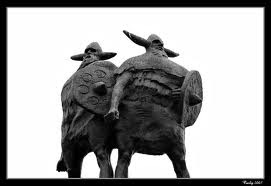
Whoa! Stop the bus! Back up a bit! Before we go on our merry way, let’s tarry awhile in Jarrow. In the 1930s, Jarrow became infamous for its mass unemployment, which led to the poignant but ultimately unsuccessful ‘Jarrow March’ or 'Jarrow Crusade' to London. However, Jarrow had an even greater claim to fame, dating from centuries before. The Monastery of Saint Paul in Jarrow was once the home of the learned monk who became known as The Venerable Bede. When it was founded, it was said to have been the only centre of learning in Europe north of Rome. Bede is most famous for his work ‘Historia Ecclesiastica Gentis Anglorum’, translated as ‘The Ecclesiastical History of the English People’, and he is recognised as the father of English history. Bede died in AD 735 and, less than 60 years later, in AD 794, the Monastery at Jarrow became the second target of Viking raiders in England, after they had sacked and plundered Lindisfarne Priory a year earlier.


Now take two giant steps forward, first to the 1960s and then to the 1990s. The good burghers of Jarrow, with all that ancient and modern history on their doorstep, are about to commission (in the 1960s) first a statue, and then (in the 1990s) to re-name their new town shopping centre. Who would YOU put your money on? That’s right, in a double fit of masochistic sentimentality; they chose to commission a Viking statue and then re-named their retail hub ‘The Viking Centre’. Murder, mayhem, robbery, rape, destruction. Now there’s a legacy to look up to!

The Journey Continues

I had (and still have) a weak stomach when it comes to long distance travel, and I dreaded the trip on the number 87 particularly because I was always sick on that bus. Mam was ever alert to the tell tale signs - my skin turning yellow, the slumping forward on the seat, the hair falling out and limbs dropping off – and she would yank me up from the seat and push me down the aisle to the rear, open platform of the bus and hold on to me as I leaned outwards to be sick. As I got older and bigger, she kindly let me hang onto the handrail myself as I threw up. All this took place as the bus sped along the road, with the conductor not even alerting the driver as to what was going on behind him but, no doubt, hoping that I wouldn’t fall off as he would have to report it and, no doubt, miss his tea break at Newcastle as a result.


The Tatler Cinema

After an hour or so, when we arrived at the terminus at Worswick Street Bus Station at Newcastle, Mam would clasp my hand and drag me along the busy roads of Pilgrim Street and Northumberland Street (which were then part of the route of the A1 or 'Great North Road' which ran through the centre of Newcastle) to another bus station at The Haymarket, where buses left for destinations northward. She was careful to circumvent the odd looking men in brown raincoats and trilby hats who were queuing to get into The Tatler Cinema (just renamed 'The Classic' in the early 1960s) which was once a news cinema but, I discovered later, now showed ‘adult’ films.

Without a break, I would be bundled onto another bus that would take us on through Morpeth and drop us off on the A1 outside Northgate hospital. This was another hour-long, uncomfortable ride and, sometimes, I would have to get off the bus in Morpeth Bus Station to be sick again in the station toilets. This would annoy Mam, as it meant that we would have to wait for yet another bus to take us out of town to the hospital.

Auntie Annie

Northgate Hospital, in the late 1950s and early 1960s, was an alien world to a small boy. This was just simply because nobody talked openly about mental illness. It was something you kept quiet about and, if someone in your family was ‘backward’, ‘retarded’ or ‘loony’, you locked them away from view. Thus, as I walked through the grounds of the hospital and into the block where Auntie Annie lived, I was both puzzled and alarmed by the behaviour and demeanour of the patients.


Auntie Annie herself was a sweet, kind and innocent woman, who lived an uncomplicated if regimented life at a place she regarded as her home. She looked forward to her weekend visitors and always greeted Mam and me with affection. Mam, as the nearest in age to her, had had to look after her at home before she was sent away, and they had a close bond. In later years, when I was in my teens and twenties, Mam would arrange to take her out on holiday to stay with her for one or two weeks. The first few days were fine but, as the holiday progressed, Auntie Annie would become more anxious and overwrought, and would become terribly homesick for the known sureties of her hospital home. These holidays became less frequent as the years progressed.

When I was about 14, I refused to go with Mam to visit Auntie Annie, I’m rather ashamed to say, with the selfish interests of youth taking precedence. Auntie Annie outlived Mam by a few years. Her demise was very sad. The only place she felt safe was at the hospital, with her fellow patient and staff friends and following her routine. She may have become institutionalised, but that was a process that had happened over many decades. She fell victim to a change in government policy and conventional wisdom which said that mental health hospital patients would fare better ‘out in the community’. After more than 50 years at Northgate Hospital, she was transferred to a smaller unit in Newcastle. Within a very few years she became ill and died. I had not seen her for many years and had not visited her at all since Mam had died. I was no longer a self-absorbed schoolboy. Auntie Annie deserved better from me.   

SUNDAYS


Sunday evoked ambivalent feelings caused by it simultaneously being part of the weekend but also, particularly in the latter part of the day, as the beginning of preparations for the next working week.

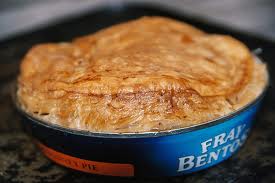
The day usually began with a quick read through the two Sunday papers, ‘The People’ and ‘The News of the World’, which was our rather low-brow way of acquiring a perspective on the wider world. Mam, in common with all the other mams, would have been up early and, after she cleaned out, made up and lit the fire in the living room, she would prepare the Sunday dinner. A particular family favourite, to go with the potatoes and veg, was tinned Fray Bentos Steak and Kidney Pie. This was such a favourite (and handy) working class meal throughout the country that, by the early 1970s, everyone understood the joke about the break-up of the former great but now ageing Manchester United football team: ‘They’re going to sell George Best to Juventus and the rest to Fray Bentos’.

The Great Ken Dodd

After or during the meal we would listen  to ‘Two Way Family Favourites’ on the radio and also the genuinely hilarious comedy shows, such as ‘Beyond Our Ken’, ‘Round the Horne’ and ‘The Ken Dodd Show’. Ken Dodd, in his later life, may have revealed himself to be a rabid Thatcherite with unreasonable fears about the trade unions, but he was, and remains, Britain’s greatest living clown. He had many catchphrases over the years, but the one I remember from my childhood was ‘Where’s me shirt?’ delivered in a thick Liverpudlian accent, and he used to weave it into all types of  sketches and punch lines in his radio shows, such as:

‘The boy stood on the burning deck
The flames began to hurt.
He said ‘If they get much higher, lads’
‘I’ll be shouting – Where’s me shirt?’


The afternoon would be a final opportunity for a bit of play in the street with the other kids before tea and an early bath. Freshly scrubbed, I would settle down to watch ‘Rawhide’ or ‘The Saint’ or whatever else was on before the last TV programme I was allowed to stay up for, which was announced as ‘Val Parnell’s Sunday Night at the London Palladium’. This was magical, live, variety entertainment and it skipped by too quickly before I was packed off to bed. The end of the weekend.


Monday, 11 November 2013

Issue No. 20: FRIDAYS

Before I was eleven, my weekend really began on Friday dinner (lunch) time, when I queued for fish and chips.

I would run out of school and meet Mam at the corner of our street and Park Avenue, and we would hurry up to the fish and chip shop. After a few years, Mam got a job packing biscuits at Wright’s Biscuit Factory across town. She would come home by bus to see to me at dinner times, before hurrying to work again. On Fridays, this meant that I would keep her place in the queue for either (the preferred) cod and chips or haddock and chips. I always feared getting to the front of this long queue and then confessing that I had no money for the order, relegating me to the back of the queue again. Luckily, Mam always arrived in the nick of time from her bus, purse at the ready. The queuing  seemed to last for ages, and I’ve no idea of how we managed to wait in line, scurry home, unpack the fish and chips from the outer wrappings of newspapers and inner wrapping of (wrongly-named) greaseproof paper, eat the large meal and then get back, respectively, to school and work.

Joe Loss
The radio was turned on at dinner times, tuned to the BBC’s ‘Light Programme’ and we chomped away, accompanied by the likes of Wilfred Pickles, hosting ‘Have a Go’, Workers’ Playtime’ or, in the pre-Radio 1 days on Fridays, the Northern Dance Orchestra or ‘The Joe Loss Pop Show’, where Joe Loss and His Orchestra and his singers would ‘cover’ the Top 10 hits. Even though there were really decent singers doing these ‘covers’, such as Ross McManus (father of Elvis Costello), the demanding public wanted to hear the real McCoy. We cruelly dubbed this last programme ‘The Dead Loss Flop Show’, in retrospect a thoroughly unfair and undeserved criticism.

Friday afternoons at school, after the big meal, were merely an irksome interlude before the weekend arrived, more so if we were given homework to complete before Monday.

I was allowed to stay up a bit later on Friday and Saturday nights, which was especially great when we eventually rented our first telly, a 12 inch, black, ‘Bakelite’ Morphy Richards, with the controls on top, inside a pop-up panel (super cool, eh?). The advent of the telly meant that by myself, throughout the week, I could now watch ‘The Lone Ranger’, ‘Champion the Wonder Horse’ and, later, other programmes, such as Richard Greene in ‘Robin Hood’, ‘William Tell’, ‘Ivanhoe’ (with Roger Moore) and a whole host of American shows, like ‘Highway Patrol’ (with Broderick Crawford), ‘Casey Jones’, ‘I Love Lucy’, ‘Popeye’, ‘The Dick Van Dyke Show’, ‘Gunsmoke’ (with James Arness), ’77 Sunset Strip’, with Effram Zimbalist Junior (a great name!) and the character ‘Kookie’...AND, later still, ‘Bonanza’, ‘Rawhide’ (with Clint Eastwood) and, my favourite, ‘The Saint’ (with Roger Moore again), on Sunday, before ‘Sunday Night at
Roger Moore as The Saint
the London Palladium’.


To be honest, staying up wasn’t a particularly big deal when, at about 10pm, both BBC and ITV shut down for the night. On the ITV channel, the local Tyne Tees Television would close the night with a religious slot, ‘The Epilogue’, which was the TV company’s way of blessing you and telling you to get to bed because you had a long day’s work ahead of you tomorrow.

Friday, 1 November 2013

Issue No. 19: GRUBB AND 'THE BEANO'


Our teachers at Grammar School were a variety of types: aloof, arrogant, bullying, caring, demanding, dangerous, interesting, encouraging, cynical, boring, inspiring and stupid.


Mr Smugsby ticked a number of the above categories. He was, amongst other things, a 'Careers Master'. He had a simple method of deciding which boys were of interest to him. He was most interested in those who wished to go to university, less interested in those who did not but stayed on to do 'A' levels, and not interested at all in any who left school at 16.

Books to Impress


In the 5th Form, we had a lesson where we were encouraged to bring in a book and read it quietly. Some boys from middle class homes had access to extensive and improving book collections at home; others, like me, did not. However, as the class teacher quite often  picked up books and looked at them, most of the students tried to bring in books that might impress him. I once brought in a book about the Battle of Königgrätz in the Austro-Prussian War in 1866, which I borrowed from the local branch library (it had a colourful and exciting picture of a cavalry charge on the cover!). I couldn't read beyond the first ten dense pages and hadn't a clue who won the battle. [In fact, the Battle of  Königgrätz (or Sadowa) was the decisive battle of the Austro-Prussian War. Prussia won the battle and this led, inexorably, to later German unification....and you know what, thereafter].


My sum total of books at home was 'King Arthur and the Knights of the Round Table' and two 'Biggles' adventures. I had read and re-read these a number of times and considered myself an expert on them. 'Why didn't they have questions about them on the English 'O' Level paper?'  I often mused.


Grubb, on the other hand, didn't care a damn about impressing the teachers. He was leaving school at the end of the year after sitting his 'O' Level and CSE exams. We all secretly envied Grubb his honest book choice - 'The Beano Annual'.

During one of these lessons, Mr Smugsby suddenly appeared, to review the future intentions of some of the class. There was no confidentiality, private encouragement or guidance involved, just him loudly confirming what external exams you were sitting, checking whether you were leaving or going into the 6th Form and what subjects you intended to take there. As he proceeded, he noted Grubb and his large, colourful book. He walked up to his desk, disdainfully lifted the book up so we could all see it and snigger, stepped back and began:

"Ah, Grubb, I see that you are leaving us this year."

Grubb looked up without answering and, never taking his eyes off Smugsby, sharpened the pencil he had taken from his top pocket.

Smugsby continued "Tell me, Grubb, what do you want to do when you leave school?"

Grubb drew himself up and dutifully answered "Become a policeman, Sir"  and then quickly checked to see if he had removed his bicycle clips.

This answer drew more sniggers, although we realised that it was probably a better paid job than the most popular Grammar School leaver choices at 16 and 18 - the Civil Service and (ironically) teacher training college, respectively.

Smugsby went on: "And let's see what 'O' Levels you are taking....Oh yes, Music and Geography, isn't it?"

Grubb nodded, licked his pencil and opened his notebook.

"I see", said Smugsby, becoming more animated in anticipation of his punchline, "If you pass both those exams I suppose you will be well qualified to lead the police band!"


We all laughed as required (actually, it was quite a good joke). Smugsby departed and sped to the staff room to share his joke, no doubt leaping up and clicking his heels in delight as he went. Grubb slowly closed his notebook, put his pencil back in his top pocket, loudly cleared his throat and resumed his painstaking investigation of the crime wave known as 'The Bash Street Kids'.

There is a postscript to the Grubb story. Very recently, I heard an unconfirmed rumour that despite years of longing to be a policeman, and succeeding in that ambition, his policeman's lot was not a happy one [perhaps they didn't let him read 'The Beano' in the panda car?].  The story has it that he lasted less than ten years in the job and then gave it all up and became a solicitor's clerk. It is said that he worked for a year or so at the prestigious regional firm of Hadaway & Choyte but then opted for the more sedate home town practice of Handel & Grissell, and he spent over thirty years in the same role there.

I have no idea whether any of this is true. Personally, I doubt it, knowing that Grubb simply lived to be a copper. It all sounds too much like a grim fairy tale to me.


Friday, 25 October 2013

Issue No. 18: NEVER GIVE A SUCKER AN EVEN BREAK


Yikes!

When I was young, I was taught that honest endeavour and hard work would always be rewarded. No doubt kids nowadays are taught the same thing. Our American kinfolk have a pithy retort – ‘Suckers!’
This was brought home to me when I was 11 years old, and in my first year at Grammar School. I was enthusiastic but useless at all sports. However, rugby, at that age, was a great leveller of talent, simply because nobody particularly had any (I exempt Ronnie Buller – see Issue No. 16).
Therefore it was to everyone’s surprise that, at the end of a morning’s PE lesson, during which we played a game of rugby, I was selected to play for the school’s Under 12s (First Year) Rugby Team. I recall that the only thing of note I did that whole match was to pick up the ball and run like hell for the white line in the distance. I was no sprinter, and the leading attack dogs of the baying pack caught me a few feet short. My shirt was grabbed and ripped; I was scratched and punched and I flailed my arms in response, punching back. I saw the line and lunged over it, scoring the only ‘try’ of my whole school career. Only I didn’t. In the excitement, confusion and heat of the moment, I had, inadvertently, run straight across and not up the field and had dived over the sideline. Oh well! However, the PE teachers must have been impressed with my tenacity if not my sense of direction and selected me for the school team. Sporting fame (or any fame) at last beckoned. 
The first competitive game was against Southmoor School in nearby Sunderland. I did nothing remarkable at all during the game. In fact, I can hardly recall touching the ball more than twice. I consoled myself that everyone else, on both teams, was equally incompetent. The score ended three points apiece. About five minutes before the end, one of the Southmoor lads kicked me in the shin and drew blood. I thought nothing of it at the time but, by Sunday night, the wound had turned septic. A couple of days later a few boils appeared, oozing puss (especially if you squeezed them hard!).

Most mothers would have taken their kids to the doctor and had some antibiotics prescribed. Not my Mam. Instead, she decided to cure the problem by applying scalding hot bread poultices in order, she said, to draw out the infection. Really, this was just an acute form of child abuse. The infection wasn’t drawn out but the process was. The torture of having hot poultices applied three times a day went on for weeks and weeks. The boils didn’t go away; they grew and multiplied, obviously enjoying the steamy heat. Eventually, the infection and the boils did recede. I guess they had simply run their course.

Mam was puzzled as to why the poultices didn’t work quicker. She speculated: Could the cloths have been hotter (you must be kidding!)? Should she have also used mustard (or jam)? Should it have been brown bread instead of white? Never once did it occur to her, during or after my weeks of agony, that maybe she should seek medical advice. In her own mind the poultices did work because the infection eventually cleared up.

By the way, I don’t want you to get the impression that Mam was into homeopathy in any way – she wasn’t. The only herb she’d heard about was the good looking trumpeter who fronted The Tijuana Brass. Mam was more into hot water and steam. Bread poultices were one manifestation. Another was me sitting with a towel over both my head and a steaming bowl of hot water to cure my sinus problems (it didn’t!). Yet another was the insistence that she had properly tested my bath water on a Sunday night, after my usual sweaty and muddy game of football, only for me to step into a bubbling cauldron. I never cleared any scum off the sides of the bath afterwards but rather a whole layer of boiled epidermis.

I couldn’t play any sports because of my enduring injury and my debut game for the school team was also my last. I tried my best but was never able to regain my place in that year or all the succeeding years of my time at Grammar School. Sucker!

Thursday, 17 October 2013

Issue No. 17: PEANUTS FROM CHARLIE BROWN

George Buist had a very big head. I say this not in any sense as a comment on his self-importance but simply as a statement of truth. George had a small, squat body and an enormous head on top of it - "Like a drum on a pea" as Mam once succinctly put it.

George was one of a number of kids from my estate (although, in his case, the 'nicer' east side) who went with me from our Junior School to the Grammar School. For a year or so, when he was eleven and twelve, George thought that he was Denis Law, the legendary Manchester United footballer. Simultaneously, he started to speak in a thick Liverpudlian accent. I'm not sure if George started to speak like a Scouser because he couldn't perfect a Denis-like Aberdonian accent or because his older sister's boyfriend was from Liverpool and he wanted to impress him. For a couple of years, his close friends endured the sight of George running around the local park playing footie in his Man.U. strip, holding onto the cuffs of his sleeves like Denis, and then trying to decipher what he was saying during and in between these sessions. George was a likeable lad. Nobody wanted to dishearten or disillusion him. However, the facts were that (like the rest of us) George was an enthusiastic but crap footballer and that no one, including his sister's Liverpudlian boyfriend, could understand a word of what he said.

'Tojo'

George and the rest of us were plagued by a younger boy who lived near him and who, despite our best efforts at dissuasion, attached himself to our group when we were at George's house. He looked like a snotty-nosed Tojo, the former Japanese Minister of War, with his round face, round NHS wire-framed glasses and close-cropped hair. Possibly unlike Tojo, he also used to stink of sweat and ancient, accumulated farts. We routinely tortured him with 'red hot pokers' and by bouncing tennis balls off his head. Sadly for him, he was called Charlie Brown. Charlie's only saving grace was that he had an older sister, a couple of years our senior, who looked like Dusty Springfield. It's fair to say that a number of us developed a crush on her, yet no one could pluck up the courage to say anything to her. Then we thought about Charlie.


Dusty Springfield
For a couple of weeks we were exceptionally nice to Charlie. We let him play with us, gave him sweets and ignored his smell. He wasn't stupid; he knew something was up. We pumped him for information about 'Dusty' - her likes and dislikes and whether she had any boyfriends, especially any bigger than us. We then composed an anonymous letter to her signed 'An Admirer' and posted it through her door. We heard nothing for a week, as Charlie had been kept in sick, with typhoid fever or cholera or something like that. Eventually, he re-appeared in George's garden. We grabbed him and asked whether 'Dusty' had got the letter.

"Errm...yes", said a reluctant Charlie.

"Well, what did she think about it?"  we asked.

Our insistence was too obvious and the penny dropped with Charlie. He squinted at us through his steamy, grubby glasses and grinned, showing yellow and brown teeth and said "She went to the toilet and wiped her bum on it!"

We were humiliated, mortified, crushed and, in a manner of speaking, wiped out. We didn't know if Charlie was telling the truth or not; there was no way of finding out. We should have thumped him anyway for being so pleased about our defeat. We didn't, we just silently sloped away home. George told us later that he had taken Charlie to one side and spoken to him quietly and at length about friendship, loyalty and sympathy towards his comrades. And then he thumped him.

Saturday, 12 October 2013

Issue No. 16: BULLY BOY


Ronnie Buller was big-boned, brawny and brutal. He was in the Junior School with me and, apart from his size, he was then fairly anonymous. When he went to the Grammar School, however, he discovered talents neither he nor anyone else who knew him could ever have guessed he possessed.

Rugby

He always seemed ungainly and rather ponderous at games, especially football. However, the senior school opened up the world of rugby to him. Still not fleet of foot, he nevertheless used his superior height and strength to great advantage. As he grew, so did his prowess on the pitch. I remember, in one rugby match, trying to tackle him round the waist. This only slowed him slightly and, as other opponents came in, he smashed them down with his free hand. A couple of other boys grabbed onto him, but he powered down the field with three of us clinging on, being thumped heavily to free his progress. He easily made the school rugby team in the successive years he was there, growing bigger all of the time.

Mean Machine

In Junior School and for the first two years at the senior school, I remember Ronnie as being affable, despite his later prowess on the rugby field. This changed in the succeeding couple of years. By the time he was fifteen, Ronnie had developed a bullying mean streak. You tried to avoid him when going home at dinner (lunch) and tea times. A normal conversation would suddenly turn nasty because of some imagined slight, and you would find yourself being pinned against a fence, or crushed in a head lock or flat on your back on the pavement with him on top. If you didn't beg for mercy or forgiveness he would simply bash you until you did.

By a series of eliminators, Ronnie eventually came face to face with his main rival for school fight champion, an equally cruel and vicious boy from across town. This, apparently, was the fight to end all fights. There was no Marquis of Queensbury rules applying here. The fight was with fists, feet, knees, elbows and heads. It was, in truth, like a gladatorial contest. If one of them fell, the other would simply kick him in the face and at full force. Eyes were gouged, hair pulled, shirts and trousers bloodily ripped and fists, clothes and shoes were smeared with the blood of both parties. After an epic and stomach-churning battle that lasted for over an hour, Ronnie emerged as the undisputed champ. He was bloodied, battered and bruised but, as they say, you should have seen the other guy!

Just a year later, when still at school, Ronnie suffered a bad bout of rheumatic fever, which nearly killed him and which weakened his heart. However, his reputation was still intact and no one bothered to take advantage of his weakened status when he returned to school. The walks home were no better; his bullying instincts were undimmed.

Ronnie suffered academically, maybe as a result of his illness. He stayed on at school, past eighteen, for another one or two years, I was told.

What happened to him? He eventually became a primary school head teacher.